
Catalan Payslip Translation
 We provide payslip translations in many languages, including Catalan. Besides letters of appointment or employment contracts, it is a very common document used to verify your past working experience or income.
Our Catalan NAATI translators provide both Catalan to English translation and English to Catalan translation services for documents.
Translate My Payslip
- Can be done within two days or faster
- Express options available
- No office visit required
- Best price guarantee
- NAATI translator stamped
- Mailed to your address
- Just submit your payslips using the form on this page for a free quote
- There are no hidden charges for fast Catalan translation by NAATI certified Catalan translators
- Many happy repeat customers
- We provide discounts for repeat customers or large orders
- NAATI certified Catalan translators for immigration or legal documents
- Full-time Catalan translators experienced in translating all kinds of documents
- Personal, friendly service
Catalan Translation Service Australia-Wide
- Sydney
- Melbourne
- Brisbane
- Perth
- Canberra
- Darwin
- Hobart
- Adelaide
- Wollongong
- Newcastle
- Cairns
- ID card translations
- Degree translations
- Diploma translations
- Passport translation
- Family register/book translations
- Employment reference translations
- Police Clearance Certificate Translation
- Change of name certificate translations
- Vaccination certificate translations
- Education certificate translations
- Employment reference translations
- Birth certificate translation
- Tertiary certificate translations
- Identity certificate translations
- Divorce certificate translations
- Baptism certificate translations
- Custody document translations
- Academic transcript translations
- Legal translation services
- Death certificate translation
- Degree certificate translations
- Marriage certificate translations
- Medical certificate/report translations
- Letters of appointment translations
- Employment contract translations
- Academic transcript translations
- Professional certificate translations
- Trade certificate translations
- Driving licence translation
- Motor cycle licence translations
- Primary school certificate translations
- Secondary certificate translations
- Vocational certificate translations
Catalan (autonym: català, for pronunciation see below) is a Western Romance language. It is the official language of Andorra, and an official language of three autonomous communities in eastern Spain: Catalonia, the Balearic Islands and the Valencian Community, where it is called Valencian (autonym: valencià). It has semi-official status in the Italian comune of Alghero, and it is spoken in the Pyrénées-Orientales department of France and in two further areas in eastern Spain: the eastern strip of Aragon and the Carche area in the Region of Murcia. The Catalan-speaking territories are often called the Països Catalans or "Catalan Countries".
The language evolved from Vulgar Latin in the Middle Ages around the eastern Pyrenees. Nineteenth-century Spain saw a Catalan literary revival, culminating in the early 1900s.
The Catalan language and culture were still vibrant during the Spanish Civil War (1936–1939), but were crushed at an unprecedented level throughout the subsequent decades due to Francoist dictatorship (1939–1975), which abolished the official status of Catalan and imposed the use of Spanish in schools and in public administration in all of Spain, while banning the use of Catalan in them. Between 1939 and 1943 newspapers and book printing in Catalan almost disappeared. Francisco Franco's desire for a homogeneous Spanish population resonated with some Catalans in favor of his regime, primarily members of the upper class, who began to reject the use of Catalan. Despite all of these hardships, Catalan continued to be used privately within households, and it was able to survive Franco's dictatorship. At the end of World War II, however, some of the harsh measures began to be lifted and, while Spanish language remained the sole promoted one, limited number of Catalan literature began to be tolerated. Several prominent Catalan authors resisted the suppression through literature. Private initiative contests were created to reward works in Catalan, among them Joan Martorell prize (1947), Víctor Català prize (1953) Carles Riba award (1950), or the Honor Award of Catalan Letters (1969). The first Catalan-language TV show was broadcast in 1964. At the same time, oppression of the Catalan language and identity was carried out in schools, through governmental bodies, and in religious centers.
- Catalan is a Romance language spoken in parts of Spain, France, Andorra, and Italy, with over 10 million speakers.
- It has more similarities with Occitan, a language spoken in southern France, than with Spanish, despite its geographic proximity to Spain.
- Catalan is the official language of Andorra and a co-official language in the Spanish regions of Catalonia, Valencia, and the Balearic Islands.
- The language experienced a period of suppression under Franco’s dictatorship in Spain but has since seen a revival.
- Catalan has its own rich literary tradition, with notable works such as "Tirant lo Blanch," a classic chivalric novel from the 15th century.
Our translators in Melbourne collaborate and work with colleagues from Sydney Translation Services to delivery fast NAATI translation services.
Melbourne is the capital and most populous city in the state of Victoria, and the second most populous city in Australia. The Melbourne City Centre is the hub of the greater metropolitan area and the Census statistical division—of which "Melbourne" is the common name. As of June 2010, the greater geographical area had an approximate population of four million. Inhabitants of Melbourne are called Melburnians or Melbournians.
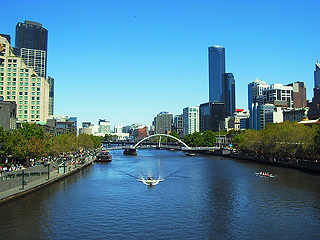
The metropolis is located on the large natural bay known as Port Phillip, with the city centre positioned at the estuary of the Yarra River (at the northernmost point of the bay). The metropolitan area then extends south from the city centre, along the eastern and western shorelines of Port Phillip, and expands into the hinterland. The city centre is situated in the municipality known as the City of Melbourne, and the metropolitan area consists of a further 30 municipalities.